Theory.10 slide · 18 phút. Tổng quan dạng process · linear vs cyclical · sequencers · passive voice · ngôn ngữ vòng tuần hoàn · cấu trúc 4 đoạn · trình tự 20 phút.
Practice 01 · Chocolate Production — Linear.9 slide · 17 phút. 7 bước · present passive · sequencers · bài mẫu 175 từ · Band 6.5.
Practice 02 · Water Cycle — Cyclical.9 slide · 17 phút. Vòng khép kín · 4 giai đoạn · ngôn ngữ vòng · bài mẫu 170 từ · Band 6.5.
Practice 03 · Cement & Concrete — Linear (two-stage).9 slide · 17 phút. Hai quy trình song song · so sánh đầu vào · bài mẫu 178 từ · Band 6.5.
Practice 04 · Salmon Life Cycle — Cyclical.9 slide · 17 phút. Vòng đời sinh học · time markers · bài mẫu 172 từ · Band 6.5.
Wrap-up & Homework.4 slide · 4 phút. Pattern chung · vocab tổng hợp · bài về nhà · lịch luyện tuần.
WelcomeObjectives
Learning Objectives
Sau 90 phút, bạn làm được năm việc.
Phân biệt linear vs cyclical process.Linear: bắt đầu A, kết thúc Z. Cyclical: vòng khép kín, không có "kết thúc". Mở bài khác nhau.
Dùng đúng passive voice cho process.Present simple passive: is heated / are collected / is then mixed with. 80% câu trong process essay là passive.
Sắp xếp sequencers trải đều bài.First → Once X-ed → Subsequently → After that → Finally. Không lặp then, then, then.
Viết overview cho process đạt Band 6.2 câu nêu: (1) số bước, loại process (linear/cyclic) · (2) đầu vào (raw materials) → đầu ra (finished product).
Phân nhóm bước thành Body 1 / Body 2.Theo giai đoạn (preparation → processing → finishing) hoặc theo địa điểm (above ground / underground).
Phần I · Lý thuyếtTổng quan dạng Process
Process Tasks · Task 1 Academic
20 phút. 150 từ. Một quy trình.
Tần suất
~10%
Ít gặp hơn line/bar nhưng điểm cao dễ ăn nếu nắm pattern. Đề thi gần đây: chocolate, brick-making, water cycle.
Đặc điểm
Steps
Quy trình có 5–10 bước được đánh số. Không có số liệu — toàn bộ là định tính & theo trình tự.
Trọng tâm
Passive
Người thực hiện không quan trọng → dùng passive impersonal: The beans are roasted (không nói ai roast).
Process = sơ đồ luồng. Có thể là sản xuất (chocolate, cement, paper) hoặc tự nhiên (water cycle, life cycle, photosynthesis).
Phần I · Lý thuyếtHai loại process
Two Process Types · Linear vs Cyclical
Hai dạng — hai cách mở bài.
Type 01 — Manufacturing
Linear
Đặc điểm: bắt đầu input cụ thể → kết thúc output cụ thể
Ví dụ: chocolate production · brick-making · paper recycling · cement & concrete
Thì: present simple passive (is heated · are collected)
Mở bài: "The diagram illustrates how X is produced / manufactured."
Sequencers: First · Once X-ed · Subsequently · Finally
Type 02 — Natural / Biological
Cyclical
Đặc điểm: vòng khép kín, không có điểm kết — output = input của vòng kế tiếp
Ví dụ: water cycle · carbon cycle · life cycle of salmon / butterfly / frog
Thì: present simple (active or passive — biological action)
Mở bài: "The diagram depicts the cycle of X / the life cycle of X."
Sequencers: Once X-ed · Subsequently · The cycle then begins again
Cyclical luôn cần câu cuối: "the cycle then repeats / begins again" — chốt vòng tuần hoàn.
Phần I · Lý thuyếtSequencers
Sequencers · Five-stage chain
Sequencers — trải đều, không lặp.
01 · Start
First / To begin / Initially
Mở đầu bài. Không bao giờ dùng "Firstly" và "Secondly" cùng nhau.
02 · Next
Once X-ed / Having been X-ed
Câu nối ưa thích band 6.5+. Once heated · Having been mixed.
03 · Then
Subsequently / Thereafter
Thay then. Đặt đầu câu, theo dấu phẩy.
04 · After
After this / Following this stage
Dùng giữa Body 1 / Body 2. Linking đoạn lớn.
05 · End / Loop
Finally / The cycle then repeats
Linear: Finally. Cyclical: begins again.
Quy tắc: trong 1 đoạn không dùng quá 2 lần cùng 1 sequencer. Trải đều 5 nhóm trên → Coherence & Cohesion lên 1 band.
Phần I · Lý thuyếtPassive voice
Passive Voice · Three patterns
Passive — vì người làm không quan trọng.
PATTERN 01
Present simple passive
is/are + V3
The beans are roasted at 120°C. The mixture is poured into moulds.
PATTERN 02
Once + past participle
Once + V3, ...
Once roasted, the beans are cracked open. Once heated, the metal is shaped.
PATTERN 03
Having been + V3
Having been V3, ...
Having been crushed, the cocoa is mixed with sugar. Having been filtered, the water flows downward.
Đừng lặp is/are V3 8 lần. Luân phiên 3 pattern trên → GRA tăng ngay 1 band.
Phần I · Lý thuyếtNgôn ngữ vòng tuần hoàn
Cyclical Language · Loop & recurrence
Vòng — không có start, không có end.
Mở bài cyclical
Opening verbs
Begins: The cycle begins with X / commences when …
Starts: X marks the beginning of the cycle
Note: "begin" — không có "the start" tuyệt đối, chỉ là điểm tiện để mô tả
Vào câu mở: "Although the cycle has no fixed starting point, it is conventional to begin with X."
Đóng vòng cyclical
Closing verbs
Repeats: the cycle then repeats / repeats itself
Begins again: the cycle begins again / starts anew
Returns: the process returns to the original stage
Recurs: the cycle recurs indefinitely / continues
Câu cuối bài cyclical bắt buộc có verb "lặp lại". Thiếu = bài thiếu kết → trừ Task Achievement.
Phần I · Lý thuyếtCấu trúc 4 đoạn
Four-paragraph structure · Process
Bốn đoạn — grouping theo giai đoạn.
~25w
PARA 01
Introduction
Paraphrase câu đề. The diagram illustrates / depicts / shows how X is produced / the cycle of X.
~40w
PARA 02
Overview
2 câu: (1) số bước / loại (linear/cyclic) · (2) input → output hoặc giai đoạn lớn.
Giai đoạn cuối (processing / packaging / loop). Câu cuối: linear → product. Cyclical → "cycle repeats".
Cách chia: 2 nửa đầu/cuối theo trình tự. Đừng chia "câu hỏi" hay "thematic" như map — process là tuyến tính theo thời gian.
Phần I · Lý thuyếtTrình tự 20 phút
Exam Sequence · 20-minute budget
20 phút — 5 bước cố định.
Phân tích đề + diagram (3 phút).Đếm số bước · xác định linear/cyclical · liệt kê input đầu (raw materials) & output cuối (product) · tìm icons / mũi tên đặc biệt.
Lên dàn bài 4 đoạn (2 phút).Chia số bước thành 2 nhóm: Body 1 = bước 1–3 (preparation), Body 2 = bước 4-cuối (processing/loop). Ghi sequencers ra giấy nháp.
Viết Intro + Overview (4 phút).~65 từ. Intro 1 câu paraphrase. Overview 2 câu: số bước / loại + input→output. Tuyệt đối không liệt kê chi tiết.
Viết Body 1 + Body 2 (9 phút).~95 từ. Mỗi câu = 1 bước. Linking: First / Once X-ed / Subsequently / After that / Finally · the cycle repeats.
Check lỗi (2 phút).Passive đúng V3? · sequencers không lặp? · subject-verb agreement? · đếm từ (≥150). Không viết thêm.
Practice · 01
01
Chocolate Production · Linear
Practice 01 · Chocolate
Chocolate. From bean to bar.
01 · Chocolate Production — linear
02 · Water Cycle — cyclical
03 · Cement & Concrete — linear (two-stage)
04 · Salmon Life Cycle — cyclical
Practice 01 · ChocolateĐề bài + sơ đồ
Task · Linear · Chocolate production
The diagram below shows how chocolate is produced from cocoa beans.
Summarise the information by selecting and reporting the main features, and make comparisons where relevant.
Roasting (chuyển đổi hoá học) · mixing (thành phẩm cuối định hình)
Bảng 7 bước
Step
Action
Verb (passive)
01
Cocoa pods harvested from trees
are picked / are harvested
02
Beans fermented for 5–7 days
are fermented
03
Dried in the sun on mats
are dried / are spread out to dry
04
Roasted in ovens at 120°C
are roasted
05
Cracked & crushed into nibs / cocoa liquor
are cracked open · are ground
06
Mixed with sugar, milk, cocoa butter
is mixed with · is combined with
07
Poured into moulds & cooled → bars
is poured into · is left to cool
Practice 01 · ChocolateBước 2 · Intro + Overview
Step 2 · Writing Intro & Overview · 4 phút
Số bước + input/output — overview gói gọn.
Câu đề gốc
"The diagram below shows how chocolate is produced from cocoa beans."
Intro paraphrased · Band 6.5
"The diagram illustrates the seven main stages involved in the production of chocolate, from the harvesting of cocoa pods to the moulding of the final bar."
Overview · 2 câu · số bước + 2 giai đoạn
OverviewOverall, it is clear that the process is linear, beginning with the cultivation of cocoa beans and ending with the production of finished chocolate bars. The stages can be divided broadly into two phases: an agricultural preparation phase and a manufacturing phase.
Overview process: không liệt kê 7 bước. Chỉ nêu xu hướng tổng + 2 phase lớn.
Practice 01 · ChocolateBước 3 · Body 1 + Body 2
Step 3 · Body paragraphs · 9 phút
Hai đoạn — cultivation 1-3 / processing 4-7.
Body 1 · CultivationThe process begins with the harvesting of cocoa pods, which are picked directly from the trees. Once harvested, the beans inside are fermented for between five and seven days, after which they are spread out on mats and dried in the sun. This first phase is purely agricultural, requiring no industrial equipment.
Body 2 · ProcessingSubsequently, the dried beans are roasted in ovens at around 120°C, then cracked open and ground into a thick paste known as cocoa liquor. After this stage, the liquor is combined with sugar, milk and cocoa butter to form a smooth mixture. Finally, the mixture is poured into moulds and left to cool, producing the chocolate bars that reach consumers.
Sequencers trải đều: begins with · Once harvested · after which · Subsequently · After this stage · Finally — sáu kết nối khác nhau.
Practice 01 · ChocolateBài mẫu hoàn chỉnh
Sample Essay · Band 6.5 · 175 words
Bài mẫu — ghép 4 đoạn.
IntroThe diagram illustrates the seven main stages involved in the production of chocolate, from the harvesting of cocoa pods to the moulding of the final bar.
OverviewOverall, it is clear that the process is linear, beginning with the cultivation of cocoa beans and ending with the production of finished chocolate bars. The stages can be divided broadly into two phases: an agricultural preparation phase and a manufacturing phase.
Body 1The process begins with the harvesting of cocoa pods, which are picked directly from the trees. Once harvested, the beans inside are fermented for between five and seven days, after which they are spread out on mats and dried in the sun. This first phase is purely agricultural, requiring no industrial equipment.
Body 2Subsequently, the dried beans are roasted in ovens at around 120°C, then cracked open and ground into a thick paste known as cocoa liquor. After this stage, the liquor is combined with sugar, milk and cocoa butter to form a smooth mixture. Finally, the mixture is poured into moulds and left to cool, producing the chocolate bars that reach consumers.
Practice 01 · ChocolatePhân tích ngôn ngữ
Language analysis · Linear process
Bốn kỹ thuật — tháo từ bài chocolate.
Passive variety"are picked · are fermented · are spread out and dried · are roasted · are cracked open · is combined with · is poured · is left to cool" — tám passive khác nhau, không lặp.
Sequencers"begins with · Once harvested · after which · Subsequently · After this stage · Finally" — sáu sequencer khác nhau, trải đều 2 body.
Reduced clauses"requiring no industrial equipment · producing the chocolate bars · known as cocoa liquor" — participle clauses để gắn lý do/kết quả → GRA.
Lexical precision"harvested · cultivation · spread out · cocoa liquor · smooth mixture · moulding" — vocabulary chuyên ngành chế biến, không dùng made · put · finished.
"Once harvested" là cấu trúc nâng band: thay after they are harvested bằng 2 từ → câu gọn hơn.
Practice 01 · ChocolateTừ vựng
Vocabulary & Collocations
Tám từ · sáu collocations — linear production.
Vocabulary (8)
harvest (v.)/ˈhɑːvɪst/
thu hoạch — pods are harvested from trees
ferment (v.)/fəˈment/
lên men — beans are fermented
cultivation (n.)/ˌkʌltɪˈveɪʃən/
canh tác, trồng trọt — agricultural cultivation
roast (v.)/rəʊst/
rang (ở nhiệt độ cao)
grind (v.)/ɡraɪnd/
nghiền — past: ground
mould (v./n.)/məʊld/
đổ khuôn — moulding · into moulds
paste (n.)/peɪst/
khối nhão — a thick paste
stage (n.)/steɪdʒ/
giai đoạn — seven main stages
Collocations (6)
be involved in the production of
được tham gia vào quá trình sản xuất
begin with / end with
bắt đầu bằng / kết thúc bằng
be combined with
được trộn / kết hợp với
be poured into moulds
được đổ vào khuôn
be left to cool
được để nguội
a smooth / thick mixture
hỗn hợp mịn / đặc
Practice 01 · ChocolateCặp paraphrase
Paraphrase pairs · Process · linear
Sáu cặp đổi — verb passive cao cấp.
how X is made→ how X is produced / manufactured · the stages involved in the production of
they pick the cocoa pods→ are harvested · are picked from the trees · are gathered
then they roast them→ Once dried, the beans are roasted · Subsequently, the beans are roasted
they put sugar in→ is combined with sugar · is mixed with sugar · sugar is added to
finally chocolate is made→ producing the chocolate bars · resulting in the finished product · yielding the final product
they let it cool→ is left to cool · is allowed to cool · cools naturally
"Once dried" / "Once harvested" — học thuộc cấu trúc Once + V3. Ăn band ngay khi thay được "after they are X-ed".
Practice · 02
02
Water Cycle · Cyclical
Practice 02 · Water Cycle
Hydrology. Sea → cloud → rain.
01 · Chocolate Production — linear
02 · Water Cycle — cyclical
03 · Cement & Concrete — linear (two-stage)
04 · Salmon Life Cycle — cyclical
Practice 02 · Water CycleĐề bài + sơ đồ
Task · Cyclical · Water cycle
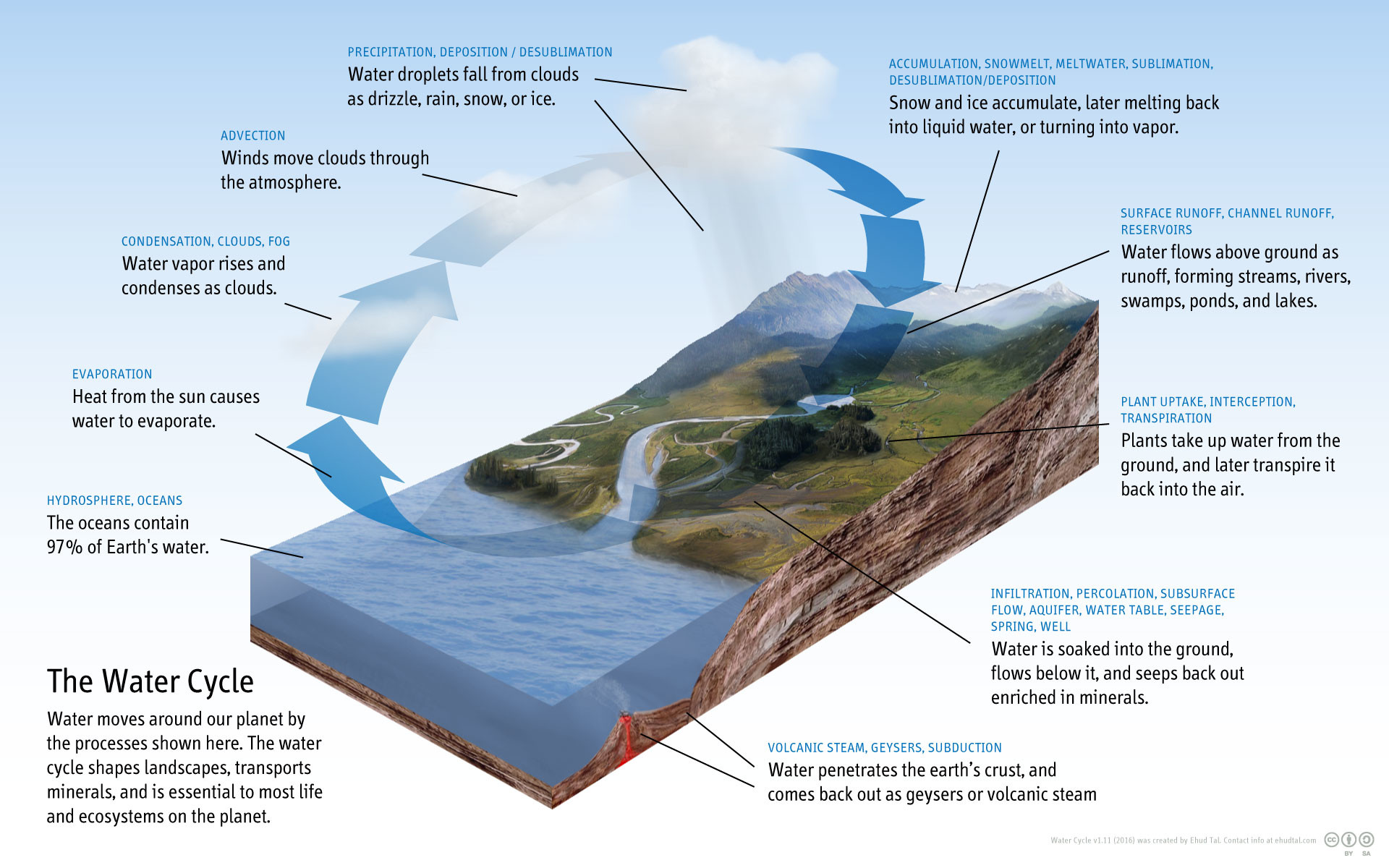
The diagram below shows the water cycle, which is the continuous movement of water on, above and below the surface of the Earth.
Summarise the information by selecting and reporting the main features, and make comparisons where relevant.
Surface runoff & groundwater chảy về biển → vòng lặp lại
Bảng 4 stages
Stage
Action
Verb
01
Sun heats water in seas / oceans → vapour rises
evaporates · is heated · rises
02
Vapour cools at altitude → forms clouds
condenses · forms · cools
03
Clouds release water as rain or snow
falls as · is released as · precipitates
04
Water flows over surface or seeps underground → returns to sea
flows · seeps · returns to · feeds back into
LOOP
Cycle begins again at the sea
the cycle then repeats / begins anew
Practice 02 · Water CycleBước 2 · Intro + Overview
Step 2 · Writing Intro & Overview · 4 phút
Cyclical — overview nhấn "continuous loop".
Câu đề gốc
"The diagram below shows the water cycle, which is the continuous movement of water on, above and below the surface of the Earth."
Intro paraphrased · Band 6.5
"The diagram depicts the water cycle, the natural and continuous process by which water circulates between the oceans, the atmosphere and the land."
Overview · 2 câu · cyclical loop
OverviewOverall, it is clear that the cycle consists of four key stages — evaporation, condensation, precipitation and collection — driven primarily by the energy of the sun. As the cycle has no fixed beginning or end, water continuously circulates between the sea, the sky and the land.
Câu thứ hai overview đặc trưng cyclical: "has no fixed beginning or end · continuously circulates".
Practice 02 · Water CycleBước 3 · Body 1 + Body 2
Step 3 · Body paragraphs · 9 phút
Hai đoạn — upward / downward.
Body 1 · UpwardIt is conventional to begin with the sea, where solar energy causes water to evaporate from the surface and rise into the atmosphere as vapour. Once it reaches a sufficient altitude, the vapour cools and condenses, forming the dense clouds that gather above both land and sea. This first half of the cycle therefore moves water from the surface upward into the sky.
Body 2 · Downward · LoopSubsequently, the moisture stored in the clouds is released as precipitation in the form of rain or snow, much of which falls onto the land. From there, water either flows over the surface as runoff or seeps underground as groundwater, and in both cases it eventually returns to the sea. At this point, the cycle begins again, repeating indefinitely.
Câu cuối Body 2 phải có "begins again / repeats" — chốt vòng tuần hoàn.
Practice 02 · Water CycleBài mẫu hoàn chỉnh
Sample Essay · Band 6.5 · 170 words
Bài mẫu — cyclical đầy đủ.
IntroThe diagram depicts the water cycle, the natural and continuous process by which water circulates between the oceans, the atmosphere and the land.
OverviewOverall, it is clear that the cycle consists of four key stages — evaporation, condensation, precipitation and collection — driven primarily by the energy of the sun. As the cycle has no fixed beginning or end, water continuously circulates between the sea, the sky and the land.
Body 1It is conventional to begin with the sea, where solar energy causes water to evaporate from the surface and rise into the atmosphere as vapour. Once it reaches a sufficient altitude, the vapour cools and condenses, forming the dense clouds that gather above both land and sea. This first half of the cycle therefore moves water from the surface upward into the sky.
Body 2Subsequently, the moisture stored in the clouds is released as precipitation in the form of rain or snow, much of which falls onto the land. From there, water either flows over the surface as runoff or seeps underground as groundwater, and in both cases it eventually returns to the sea. At this point, the cycle begins again, repeating indefinitely.
Practice 02 · Water CyclePhân tích ngôn ngữ
Language analysis · Cyclical process
Bốn kỹ thuật — tháo từ bài Water Cycle.
Cyclical phrases"continuously circulates · has no fixed beginning or end · the cycle begins again · repeating indefinitely" — bốn cụm chuyên cho cyclical, không thấy ở linear.
Verb variety"evaporate · rise · cools and condenses · is released as · flows · seeps · returns" — bảy verb mô tả pha thay đổi vật lý.
Reduced clauses"forming the dense clouds · much of which falls · stored in the clouds · repeating indefinitely" — relative clauses + participle clauses → câu phức tự nhiên.
Either-or structure"either flows over the surface as runoff or seeps underground as groundwater" — cấu trúc song song để mô tả 2 nhánh.
"It is conventional to begin with…" — câu mở Body 1 đặc trưng cho cyclical. Học thuộc.
Practice 02 · Water CycleTừ vựng
Vocabulary & Collocations
Tám từ · sáu collocations — cyclical / hydrology.
Vocabulary (8)
circulate (v.)/ˈsɜːkjəleɪt/
tuần hoàn — water circulates between sea and sky
evaporate (v.)/ɪˈvæpəreɪt/
bay hơi
condense (v.)/kənˈdens/
ngưng tụ
precipitation (n.)/prɪˌsɪpɪˈteɪʃən/
giáng thuỷ (rain / snow / hail)
runoff (n.)/ˈrʌnɒf/
dòng chảy bề mặt
seep (v.)/siːp/
ngấm, thấm — seeps underground
altitude (n.)/ˈæltɪtjuːd/
độ cao — sufficient altitude
vapour (n.)/ˈveɪpə/
hơi (nước) — water vapour
Collocations (6)
a continuous / natural process
quy trình liên tục / tự nhiên
has no fixed beginning or end
không có điểm bắt đầu / kết thúc cố định
be released as precipitation
được giải phóng dưới dạng giáng thuỷ
flow over the surface
chảy trên bề mặt
return to / feed back into
trở lại / quay về (nguồn ban đầu)
repeat indefinitely
lặp lại không ngừng
Practice 02 · Water CycleCặp paraphrase
Paraphrase pairs · Cyclical
Sáu cặp đổi — cyclical-specific.
water moves continuously→ circulates continuously · undergoes a continuous process · is in constant motion
water turns into vapour→ evaporates · rises as vapour · is converted into vapour
clouds form→ vapour condenses into clouds · clouds gather · clouds are formed
it rains→ precipitation falls · water is released as rain · clouds release moisture
water goes back to the sea→ returns to the sea · feeds back into the ocean · flows back to its source
the cycle starts over→ the cycle begins again · repeats indefinitely · starts anew
"Repeats indefinitely" — sang xịn hơn "happens again". Cũng không cần subject mới.
Practice · 03
03
Cement & Concrete · Linear · two-stage
Practice 03 · Cement & Concrete
Cement. Limestone → concrete.
01 · Chocolate Production — linear
02 · Water Cycle — cyclical
03 · Cement & Concrete — linear (two-stage)
04 · Salmon Life Cycle — cyclical
Practice 03 · Cement & ConcreteĐề bài + sơ đồ
Task · Linear · two-stage
The diagrams below show the stages and equipment used in the cement-making process, and how cement is used to produce concrete for building purposes.
Summarise the information by selecting and reporting the main features, and make comparisons where relevant.
"The diagrams below show the stages and equipment used in the cement-making process, and how cement is used to produce concrete for building purposes."
Intro paraphrased · Band 6.5
"The two diagrams illustrate the manufacture of cement and the subsequent use of that cement, together with three other ingredients, to produce concrete for the construction industry."
Overview · 2 câu · 2 sơ đồ
OverviewOverall, it is clear that cement production is a five-step linear process beginning with raw limestone and clay and ending with bagged cement. Concrete, by contrast, is made in a single mixing stage that combines cement with three other materials in fixed proportions.
Two-stage overview: 1 câu mô tả Stage A (số bước, input/output), 1 câu mô tả Stage B (đặc trưng).
Practice 03 · Cement & ConcreteBước 3 · Body 1 + Body 2
Step 3 · Body paragraphs · 9 phút
Body 1 = Stage A. Body 2 = Stage B + ratios.
Body 1 · CementThe cement-making process begins with limestone and clay, which are crushed and then mixed into a fine powder. This powder is subsequently heated in a large rotating kiln, where chemical changes occur at high temperatures. Once heated, the resulting material is ground into a finer powder and finally packed into bags, ready for sale or further use.
Body 2 · ConcreteConcrete is produced in a single mixing stage. To obtain the final product, four ingredients are combined in a rotating concrete mixer in the following proportions: 50% gravel, 25% sand, 15% cement and 10% water. The result is a wet mixture that hardens once poured, suitable for a wide range of building purposes.
Khi có tỉ lệ — phải nêu đầy đủ trong Body 2. Liệt kê từ lớn nhất xuống nhỏ nhất (gravel 50% → water 10%).
Practice 03 · Cement & ConcreteBài mẫu hoàn chỉnh
Sample Essay · Band 6.5 · 178 words
Bài mẫu — two-stage process.
IntroThe two diagrams illustrate the manufacture of cement and the subsequent use of that cement, together with three other ingredients, to produce concrete for the construction industry.
OverviewOverall, it is clear that cement production is a five-step linear process beginning with raw limestone and clay and ending with bagged cement. Concrete, by contrast, is made in a single mixing stage that combines cement with three other materials in fixed proportions.
Body 1The cement-making process begins with limestone and clay, which are crushed and then mixed into a fine powder. This powder is subsequently heated in a large rotating kiln, where chemical changes occur at high temperatures. Once heated, the resulting material is ground into a finer powder and finally packed into bags, ready for sale or further use.
Body 2Concrete is produced in a single mixing stage. To obtain the final product, four ingredients are combined in a rotating concrete mixer in the following proportions: 50% gravel, 25% sand, 15% cement and 10% water. The result is a wet mixture that hardens once poured, suitable for a wide range of building purposes.
Practice 03 · Cement & ConcretePhân tích ngôn ngữ
Language analysis · Two-stage with proportions
Bốn kỹ thuật — tháo từ bài Cement.
Passive variety"are crushed · are mixed · is heated · is ground · is packed · is produced · are combined · hardens" — bảy passive + 1 active intransitive (hardens).
Sequencers"begins with · then · subsequently · Once heated · finally · The result is" — đủ 5 cấp độ sequencer + 1 result-marker.
Comparing two stages"by contrast · in a single mixing stage · together with three other ingredients" — linking giữa 2 sơ đồ chứ không chỉ trong 1.
Proportions"in fixed proportions: 50% gravel, 25% sand, 15% cement and 10% water" — liệt kê tỉ lệ từ lớn → nhỏ, dùng colon → mạch lạc.
"In the following proportions: …" là cụm chuẩn cho diagram có tỉ lệ. Học thuộc.
Practice 03 · Cement & ConcreteTừ vựng
Vocabulary & Collocations
Tám từ · sáu collocations — manufacturing.
Vocabulary (8)
manufacture (v./n.)/ˌmænjəˈfæktʃə/
sản xuất công nghiệp — the manufacture of cement
crush (v.)/krʌʃ/
nghiền nát (thô)
kiln (n.)/kɪln/
lò nung (kiềm) — rotating kiln
grind (v.)/ɡraɪnd/
nghiền mịn — past: ground
proportion (n.)/prəˈpɔːʃən/
tỉ lệ — in fixed proportions
harden (v.)/ˈhɑːdən/
đông cứng (tự thân) — concrete hardens once poured
subsequent (adj.)/ˈsʌbsɪkwənt/
tiếp theo — the subsequent use of cement
construction (n.)/kənˈstrʌkʃən/
xây dựng — construction industry
Collocations (6)
a five-step linear process
quy trình tuyến tính 5 bước
in fixed proportions
theo tỉ lệ cố định
a single mixing stage
một giai đoạn trộn duy nhất
be packed into bags
được đóng vào bao
be combined / blended with
được kết hợp với
for building / construction purposes
cho mục đích xây dựng
Practice 03 · Cement & ConcreteCặp paraphrase
Paraphrase pairs · Manufacturing
Sáu cặp đổi — linear two-stage.
how cement is made→ the manufacture of cement · the cement-making process · how cement is produced
they break the rocks→ are crushed · are broken down · are pulverised
they heat it→ is heated · is fired in a kiln · is exposed to high temperatures
they put X% of each→ are combined in fixed proportions of · in a ratio of · containing X% of
it becomes hard→ hardens once poured · sets · solidifies
to use for building→ for construction purposes · for building applications · in the construction industry
"Hardens once poured" — câu Band 7+ vì gói gọn 2 ý (hardens + once poured) bằng 3 từ.
Practice · 04
04
Salmon Life Cycle · Cyclical
Practice 04 · Salmon
Salmon. Egg → fry → adult.
01 · Chocolate Production — linear
02 · Water Cycle — cyclical
03 · Cement & Concrete — linear (two-stage)
04 · Salmon Life Cycle — cyclical
Practice 04 · SalmonĐề bài + sơ đồ
Task · Cyclical · Salmon life cycle
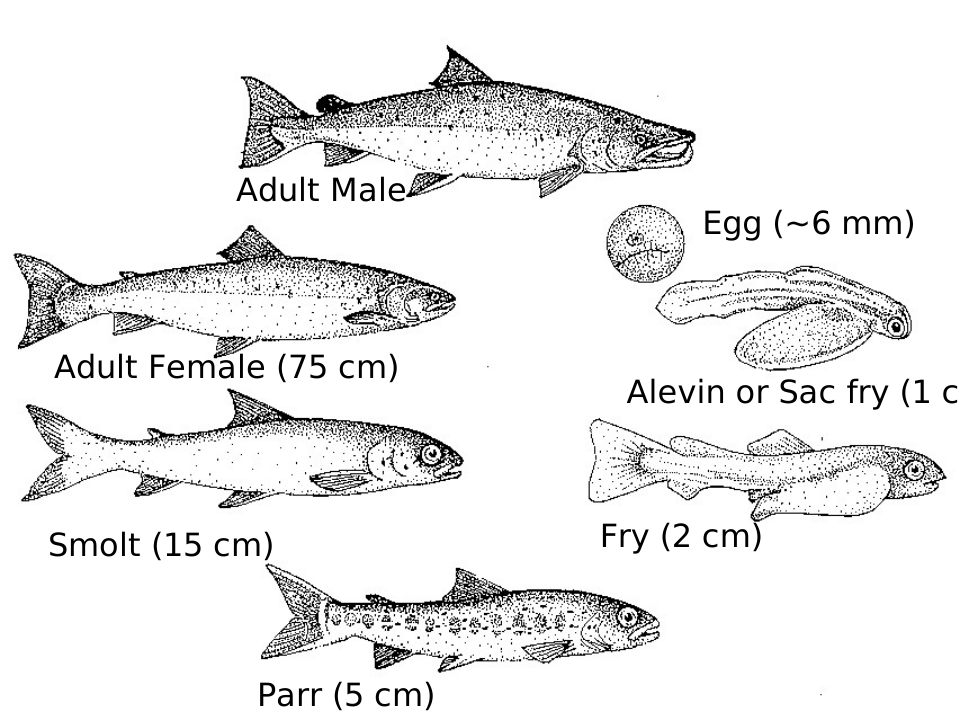
The diagram below shows the life cycle of a salmon, from egg to mature adult.
Summarise the information by selecting and reporting the main features, and make comparisons where relevant.
Loại: cyclical · 5 stages.
Time markers: 5–6 months · 4 years · returns to spawn.
Locations: river · sea · river.
Salmon Life Cycle · 5 stages
Source · Wikimedia Commons · Public Domain (Chiswick Chap)
Practice 04 · SalmonBước 1 · Phân tích
Step 1 · Analyse & Plan · 5 phút
Bốn câu hỏi — life-cycle thinking.
Q1
Loại đề?
Cyclical · 5 stages · biological life cycle
Q2
Bắt đầu từ đâu?
Egg (trứng) — convention, dễ kể
Q3
Body chia?
Body 1 = freshwater (1-3) · Body 2 = sea + return (4-5)
Q4
Time markers?
5-6 tháng (egg) · 2 năm (smolt) · 4 năm (adult) — phải đưa vào bài
Bảng 5 stages
Stage
Description
Verb
01
Egg laid in river gravel · hatches after 5–6 months
are laid · hatch · develop
02
Fry — small juveniles living in river
emerge as · grow into
03
Smolt — migrate downstream to sea (~2 yrs)
migrate · travel downstream
04
Adult — mature in sea for ~4 years
mature · feed · grow
05
Spawning — return upstream to lay eggs → cycle repeats
return to · spawn · lay eggs
Practice 04 · SalmonBước 2 · Intro + Overview
Step 2 · Writing Intro & Overview · 4 phút
Life cycle — 5 stages, 2 environments.
Câu đề gốc
"The diagram below shows the life cycle of a salmon, from egg to mature adult."
Intro paraphrased · Band 6.5
"The diagram depicts the five-stage life cycle of the salmon, tracing the fish from its emergence as an egg in freshwater to its eventual return as a spawning adult."
Overview · 2 câu · 2 môi trường
OverviewOverall, it is clear that the salmon spends the early stages of its life in freshwater rivers, migrates to the sea to mature, and finally returns to its original river to reproduce. The cycle, which spans roughly six years, then begins again with a new generation of eggs.
Overview life cycle: 1 câu mô tả tổng quỹ đạo · 1 câu nhấn vòng lặp ("begins again").
Practice 04 · SalmonBước 3 · Body 1 + Body 2
Step 3 · Body paragraphs · 9 phút
Body 1 = river · Body 2 = sea + return.
Body 1 · FreshwaterThe cycle begins when eggs are laid in the gravel of a riverbed, where they remain protected for between five and six months before hatching. Once hatched, the young fish, known as fry, grow gradually in the freshwater environment. After about two years, they reach the smolt stage and migrate downstream from the river toward the sea.
Body 2 · Sea + ReturnIn the sea, the smolts develop into mature adult salmon over a period of approximately four years, feeding and growing to full size. Subsequently, the adults return to the very river where they were born in order to spawn, laying their own eggs in the gravel. At this point, the cycle begins again with the next generation.
Time markers tích hợp: "between five and six months · about two years · approximately four years" — luôn dùng adverbs of approximation.
Practice 04 · SalmonBài mẫu hoàn chỉnh
Sample Essay · Band 6.5 · 172 words
Bài mẫu — life cycle hoàn chỉnh.
IntroThe diagram depicts the five-stage life cycle of the salmon, tracing the fish from its emergence as an egg in freshwater to its eventual return as a spawning adult.
OverviewOverall, it is clear that the salmon spends the early stages of its life in freshwater rivers, migrates to the sea to mature, and finally returns to its original river to reproduce. The cycle, which spans roughly six years, then begins again with a new generation of eggs.
Body 1The cycle begins when eggs are laid in the gravel of a riverbed, where they remain protected for between five and six months before hatching. Once hatched, the young fish, known as fry, grow gradually in the freshwater environment. After about two years, they reach the smolt stage and migrate downstream from the river toward the sea.
Body 2In the sea, the smolts develop into mature adult salmon over a period of approximately four years, feeding and growing to full size. Subsequently, the adults return to the very river where they were born in order to spawn, laying their own eggs in the gravel. At this point, the cycle begins again with the next generation.
Practice 04 · SalmonPhân tích ngôn ngữ
Language analysis · Life cycle
Bốn kỹ thuật — tháo từ bài Salmon.
Cyclical phrases"the cycle begins · then begins again with a new generation · spans roughly six years · the very river where they were born" — bốn cụm vòng tuần hoàn + relative clause.
Verb variety"are laid · hatching · grow gradually · migrate downstream · develop into · return to · spawn · laying" — tám verb mô tả phát triển sinh học.
Time markers"for between five and six months · After about two years · over a period of approximately four years" — adverb of approximation cho time → tự nhiên.
Reduced clauses"feeding and growing to full size · laying their own eggs · known as fry · where they were born" — participle + relative clauses → câu phức.
"The very river where they were born" — câu nhấn (very) + relative clause → ăn band Lexical Resource.
Practice 04 · SalmonTừ vựng
Vocabulary & Collocations
Tám từ · sáu collocations — life cycle.
Vocabulary (8)
hatch (v.)/hætʃ/
nở (trứng) — eggs hatch after 6 months
fry (n.)/fraɪ/
cá con (giai đoạn đầu)
smolt (n.)/sməʊlt/
cá hồi giai đoạn di cư
migrate (v.)/maɪˈɡreɪt/
di cư — migrate downstream
spawn (v.)/spɔːn/
đẻ trứng (cá) — return to spawn
mature (v./adj.)/məˈtʃʊə/
trưởng thành — mature adult
downstream (adv.)/ˌdaʊnˈstriːm/
xuôi dòng (về phía hạ nguồn)
gravel (n.)/ˈɡrævəl/
sỏi (đáy sông) — eggs in the gravel
Collocations (6)
the life cycle of
vòng đời của
spans roughly X years
kéo dài khoảng X năm
a new generation of
một thế hệ mới của
return to / migrate to
quay lại / di cư đến
develop into / grow into
phát triển thành
in order to spawn / reproduce
để đẻ trứng / sinh sản
Practice 04 · SalmonCặp paraphrase
Paraphrase pairs · Life cycle
Sáu cặp đổi — cyclical biology.
how a salmon lives and grows→ the life cycle of the salmon · the developmental stages of · how the salmon develops
eggs come out of the egg→ eggs hatch · the young emerge from · fry develop from
the fish goes to the sea→ migrates to the sea · travels downstream · moves out to open water
it grows up→ matures · develops into an adult · grows to full size
it goes back to the river→ returns to its original river · migrates upstream · travels back to the spawning grounds
it lays eggs again→ spawns · reproduces · produces a new generation of eggs
"To the very river where they were born" — câu Band 7+ vì very + relative clause.
Phần VI · Tổng kếtPattern chung
Common pattern · Across all 4 essays
Một khung — bốn bài.
01 · Intro (1 câu)
Linear: "The diagram illustrates the X-step process by which Y is produced." · Cyclical: "The diagram depicts the cycle of X / the life cycle of X."
02 · Overview (2 câu)
Câu 1: số bước / 2 phase / loại process. Câu 2: input→output (linear) hoặc "no fixed beginning / cycle repeats" (cyclical).
03 · Body 1 (3-4 câu)
Nửa đầu của process: cultivation / preparation / freshwater stage. Sequencers: begins with · Once X-ed · after which.
04 · Body 2 (3-4 câu)
Nửa sau + chốt: Linear → "Finally, the product is …". Cyclical → "the cycle then begins again".
Cùng khung 4 đoạn — chỉ thay cyclical phrases ở overview & câu cuối Body 2 là đủ phân biệt 2 loại.
Phần VI · Tổng kếtVocab tổng hợp
Vocabulary consolidation · 24 verbs to memorise
Hai mươi bốn verbs — đủ dùng cho mọi process / cycle.
Sequencers
begins with / starts with
Once + V3
Having been + V3
after which
Subsequently
After this stage
Finally / At this point
The cycle then repeats
Action verbs (passive)
are crushed / ground
are heated / fired
are mixed / combined
are packed / bagged
is poured / moulded
is left to cool
are released as
are laid / hatched
Cyclical phrases
circulate continuously
has no fixed beginning
spans roughly X years
begins again / repeats
a new generation of
migrate downstream
return to / feed back into
the cycle recurs indefinitely
Học theo cột: cột 1 (sequencers) cho mọi bài · cột 2 (action) cho linear · cột 3 (cyclical) cho life cycle / water cycle.
Phần VI · Tổng kếtBài về nhà
Homework · Practice schedule
Bài về nhà — 3 bài trong 1 tuần.
Viết lại Practice 02 (Water Cycle) trong 20 phút.Không nhìn bài mẫu. Mục tiêu: ≥ 4 cyclical phrases (begins · circulates · returns · repeats), ≥ 6 passive đa dạng. So với bài mẫu — gạch chân 3 sequencer khác nhau.
Tìm 1 process diagram Cambridge IELTS 17/18/19, viết trong 20 phút.Áp dụng quy trình 5 bước. Đếm từ ≥150. Gửi bài cho cô qua Notion để chấm.
Học thuộc 24 phrases ở slide 48 (8 phrases/ngày, 3 ngày).Cách kiểm tra: tự dịch 1 process bất kỳ trong sách Khoa học (vd: quá trình quang hợp) ra tiếng Anh, dùng đủ 8 phrases mỗi cột.
Đọc 2 sample essay Band 7+ về process trên BC site.simon.com hoặc ieltsliz.com — chọn 1 linear + 1 cyclical. Highlight passive verbs & sequencers. Note sổ.
End.
Lesson 04 · Process & Cycle · 50 slides · Cmd+P để xuất PDF